
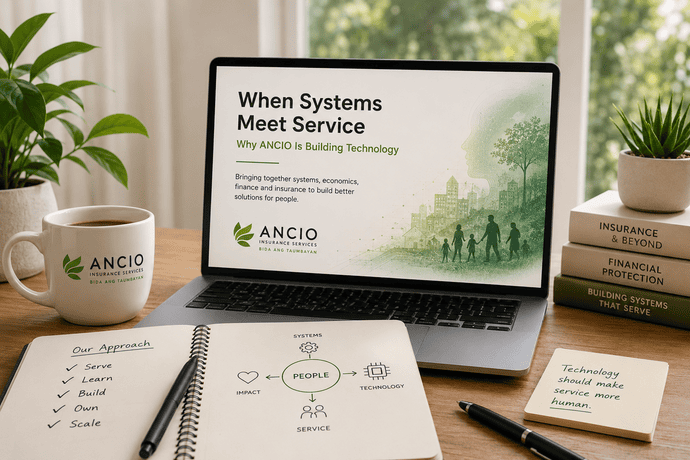
When Systems Meet Service: Why ANCIO Is Building Technology
How our journey from systems development to economics, finance and insurance is shaping the next chapter of ANCIO
If you first came to know ANCIO through insurance, you may have noticed that we have increasingly been talking about technology, systems and artificial intelligence.
So a reasonable question is: Why is an insurance services company building technology?
The answer actually begins long before ANCIO.
And one thing is important to say from the start:
We are not leaving insurance behind.
In fact, our experience in insurance and financial services is helping shape the technology we are building.
Before insurance, there were systems
My own journey began in computer science and systems development.
I learned to look at organizations as systems: to understand how information moves, how processes connect, where bottlenecks occur, and how technology can make things work better.
Later, I pursued graduate studies in Applied Business Economics.
That added another perspective. Technology does not exist in isolation. Businesses operate within markets. Incentives matter. Resources are limited. And ultimately, a good system must create real value for the people and organizations using it.
Then came finance and insurance.
At first, these may have seemed like different chapters in a career.
Looking back, however, they were gradually building toward the same question:
How can technology, business and financial systems work better for people?
What service taught us
Working in insurance and financial services brought us closer to problems that cannot always be understood from behind a computer screen.
We encountered complicated processes. Products and policies that can be difficult to understand. Information scattered across different channels. People who know they need protection but aren't always sure where to begin.
These are not necessarily technology problems.
They are human problems happening inside systems.
And that distinction matters.
Many technology companies begin with a technology and then search for a problem where it can be applied.
ANCIO is coming from the other direction.
We start with the problem.
We learn by providing the service. We observe where people struggle. We understand the workflow and the institutions surrounding it.
Then we ask:
Can we build a better system?
Then AI changed what was possible
We did not wake up one morning and decide to build AI simply because artificial intelligence had become popular.
The questions came first.
AI expanded the range of answers available to us.
Capabilities that once required enormous technical teams and resources are becoming accessible to smaller organizations.
Natural-language interfaces can make complicated information easier to understand. Voice and multilingual AI can potentially make digital services more accessible to people who may not be comfortable navigating traditional software interfaces.
Documents can become conversations. Complex processes can become guided experiences. Information can become easier to find and understand.
For a country as linguistically diverse as the Philippines, we believe those capabilities deserve serious exploration.
And so the different parts of our journey began to converge.
Systems development taught us how to build.
Economics taught us to think about value, incentives and scale.
Finance and insurance brought us closer to real-world problems.
AI expanded what we could realistically do about them.
That convergence is helping shape ANCIO today.
What this means for our insurance clients
Technology should not make insurance more complicated.
Our goal is the opposite.
We are exploring how technology can help make protection easier to understand and insurance services easier to navigate—from explaining coverage and answering common questions to guiding people toward the appropriate information, products and assistance.
This thinking is also behind Muning, the AI platform we are developing to make information and services more conversational, accessible and eventually multilingual.
Insurance provides one of our first real-world environments for learning how such technology can genuinely help people.
But technology will not replace the human side of insurance.
There are conversations that require judgment. There are circumstances that require empathy. And there are decisions where people should be able to speak with another person.
We see technology as something that can support better service—not become a substitute for service itself.
We are not leaving services behind
Our move into technology is therefore not a rejection of insurance.
Quite the opposite.
Services keep us close to reality.
They expose us to actual customers, actual processes and actual institutional constraints. They give us domain knowledge that cannot be acquired simply by building a technology demo.
Technology gives us another possibility: turning some of what we learn through service into systems that can eventually reach more people.
That is why we increasingly think about the ANCIO approach this way:
Serve. Learn. Build. Own. Scale.
Serve real people.
Learn from real problems.
Build systems around what we learn.
Own meaningful technology and intellectual property.
Scale what proves useful.
From using technology to creating it
There is also a larger reason this matters to us.
The Philippines has built extraordinary capabilities in services. Filipino professionals serve companies and institutions around the world, and those industries have created millions of livelihoods.
We should continue building on that strength.
But we believe there is another opportunity ahead.
Services create livelihoods. Technology ownership creates leverage.
The Philippines should not have to choose between being a great services economy and becoming a technology-creating economy.
We can be both.
We can use the world's best technologies. We can work with global partners. We can participate in international technology ecosystems.
And at the same time, we can deliberately build Filipino companies, Filipino products, Filipino systems and Filipino intellectual property.
For ANCIO, that ambition begins on a very small scale.
We are building around problems we have learned to understand—starting with financial protection and access to information, and gradually exploring how the same thinking can be applied to other services and communities.
We still have much to learn.
The real measure will not be how many technologies we talk about or how many prototypes we build. It will be whether the systems we create are genuinely useful to the people they are intended to serve.
Coming full circle
In some ways, ANCIO's journey into technology is not really a pivot.
It is a return.
A journey that began with systems development passed through economics, finance, insurance and entrepreneurship—and has now come back to building systems with a deeper understanding of the problems those systems are meant to solve.
AI did not create that journey.
It gave us new tools with which to continue it.
And we will continue serving through insurance while building technology from what those experiences teach us.
Serve. Learn. Build. Own. Scale.
Build here. Own here. Scale everywhere. 🇵🇭
— ANCIO