
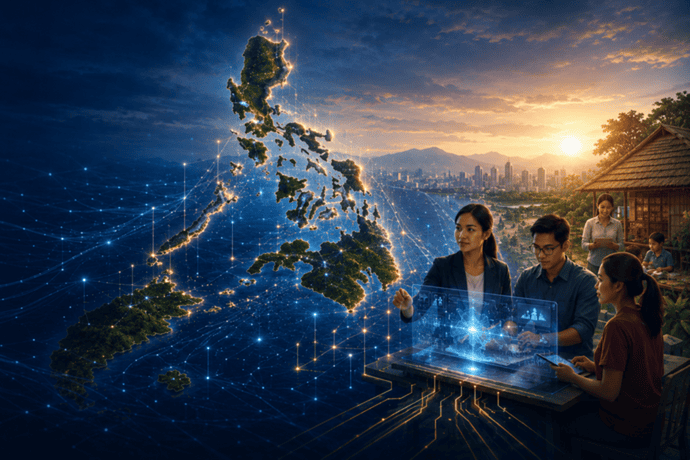
A Philippine reflection on Bill Gates’s warning about the turbulent AI era
Artificial intelligence is not approaching the Philippines. It is already here.
Filipinos are using it to write, research, code, teach, sell, design and answer customers. Companies are beginning to place it inside their operations. Government agencies are exploring how it can improve public services. Students use it every day, sometimes more quickly than their schools can decide what to do with it.
The question is no longer whether Filipinos will use AI.
The more urgent question is whether we will help build and own the systems that increasingly shape our work, institutions and economy.
A warning from someone who has seen a technology revolution before
In a recent essay, Bill Gates wrote that AI could become either “the greatest equalizer ever invented, or the worst source of injustice.” He believes the transition will be among the most turbulent periods in human history and warns that the world still has no adequate plan for it.
His concern is not limited to chatbots becoming more capable. AI can increasingly perform work that requires language, analysis, judgment and other forms of human cognition. It will affect customer service, law, medicine, software, manufacturing and many other fields. Unlike earlier economic transitions that unfolded over several generations, this one could move across industries within a decade.
Gates identifies three major risks: permanent job losses, the use of AI for fraud and other forms of harm, and the possibility that it weakens human relationships and critical thinking. He calls for new institutions to manage the transition, stronger social protection, a rebalancing of taxes on labor and capital, and some areas of work to remain “Human Reserved.”
These are serious warnings from someone who helped build the personal-computer revolution and later spent decades working on health, education and inequality around the world.
But for the Philippines, there is another question that deserves equal attention.
What if we lose the work but do not own what replaces it?
The Philippine economy has benefited enormously from exporting services and human knowledge work. Business-process outsourcing created jobs, supported families and helped build a professional middle class. Filipino workers became valued around the world for customer service, accounting, administration, software, creative work and many other services.
Unfortunately, many of these are also areas where AI is advancing quickly.
No one can say with certainty how many jobs will disappear, how many will change or how many new ones will be created. We should be careful about treating forecasts as settled fact. But it would be equally careless to assume that our current advantages will remain untouched.
The United States and China will also face disruption. The difference is that they are competing to own the models, chips, cloud platforms, robotics, research laboratories and companies producing the new wealth.
The Philippines could face a double loss: part of the service work we currently perform may be automated, while much of the profit, intellectual property and technological learning from the replacement systems accrues somewhere else.
For countries at the center of AI development, the main economic question may be how to distribute the gains. For the Philippines, the question is also whether we will capture enough of those gains in the first place.
Using AI is not the same as owning technology
The Philippines may become one of the world’s most enthusiastic users of AI while owning very little of the value it creates.
Paying for an AI subscription is adoption. Adding a chatbot to a website is adoption. Training employees to write better prompts is useful, but it is still not the same as building technological capability.
Capability means being able to design a system around a real problem, integrate it into actual operations, evaluate its accuracy and safety, improve it through experience, and retain the knowledge and intellectual property created along the way.
Ownership does not mean that the Philippines must immediately build a frontier model to rival the largest laboratories in the United States or China. That would require extraordinary amounts of capital, computing power and research talent.
But Filipino companies can own the layer built around those models:
- local applications and software platforms;
- Philippine data structures and knowledge systems;
- industry-specific workflows;
- local-language and cultural context;
- integrations with domestic institutions;
- customer and community relationships;
- and the intellectual property created through repeated use and improvement.
We can collaborate globally without surrendering the entire value chain. We can use frontier technologies built elsewhere while deliberately creating Filipino-owned systems on top of them.
Why there is urgency
There is an unusual opening today. AI capabilities that once required a large research organization are becoming accessible to small companies and independent builders. The cost of using capable models has fallen dramatically, while smaller and open-weight models continue to improve.
This lowers the barrier for a Filipino startup to build useful technology for insurance, agriculture, health, education, local government or small businesses.
Of course, building Filipino-owned AI is easier said than done. We still face expensive electricity, uneven connectivity, limited access to compute and capital, fragmented data, and the usual bureaucratic obstacles to starting and scaling a company. Ownership cannot be produced by slogans alone.
But these constraints are also why we should begin with focused, practical applications rather than wait until the Philippines has perfect infrastructure. Capability is built gradually—one working system, one real deployment and one locally retained body of knowledge at a time.
But the same opening will not remain equally open forever.
The companies and countries moving now are accumulating more than code. They are accumulating users, data, institutional partnerships, distribution channels, operational knowledge and trust. These advantages compound. A product can be copied; years of learning inside a real industry or community are much harder to reproduce.
This does not mean Filipino founders should rush into every possible AI idea. Urgency without focus produces prototypes that never become dependable systems. The better response is focused urgency: solve one important problem, work with real users, learn from deployment, retain the IP and build from there.
Experience alone does not become ownership
There is a familiar hope in development policy that participation in foreign investment and global supply chains will allow Filipino workers and companies to learn as they go.
Learning by doing is real. But performing an assigned task is not the same as acquiring the ability to design, own and commercialize the underlying technology.
A worker may become highly skilled at operating a foreign-owned system without gaining access to its source code, product architecture, patents, design tools, proprietary data or commercial rights. The worker learned, but the country may still own nothing new.
In the age of AI, converting experience into technology is easier—but it remains deliberate. It requires technical capability, capital, access, an organization willing to take the risk, and a conscious decision to turn operational knowledge into an owned product.
Technology does not simply spill over because advanced firms and local workers occupy the same economic zone. Local capability must be designed into the arrangement, supported and measured.
Ownership is not enough without agency
AI will increasingly influence decisions involving employment, credit, insurance, health care, education and public services. Filipinos should not only own some of the systems. We must also have a meaningful voice in deciding:
- what should be automated;
- what must remain human;
- what data may be collected and used;
- how an automated decision can be questioned;
- whose language and lived experience are represented;
- and how the gains from greater productivity are shared.
This is why local communities matter. A system that works well in a laboratory or corporate presentation may fail inside a barangay where records, connectivity, language, trust and institutional responsibilities are very different.
AI policy cannot be designed only from the top. The technology must be tested in real communities, with the people who will live with its consequences.
What this means for ANCIO
At ANCIO, we do not believe that technology exists in isolation.
Our work in systems development, economics, finance and insurance has shown us that the hardest problems are rarely technical alone. They involve trust, institutions, incentives, access and the realities of implementation.
This is why we are building Filipino-owned systems around actual Philippine needs. We use global AI capabilities, but our objective is to retain the local applications, workflows, institutional learning and intellectual property created from them.
Initiatives such as Pax Silica may eventually bring valuable infrastructure, investment and opportunities to the Philippine technology ecosystem. But its plans are still being negotiated, and building a major industrial ecosystem will take time.
ANCIO is not waiting for those plans to be completed before beginning its own work. We are starting with what is already within reach: global AI tools, Filipino domain knowledge, real institutional problems and the ability to build and learn from small but practical deployments.
This is not a rejection of international cooperation. It is a recognition that Filipino capability must also grow from local initiative. If larger investments and infrastructure arrive, Filipino companies should be ready to participate not only as users or service providers, but as builders with technologies, experience and intellectual property of their own.
The best time to begin developing local capability is while the cost of building is falling and many important problems remain unsolved.
The choice before us
Bill Gates is right that the world needs a plan to ensure that the benefits of AI outweigh the harm.
For the Philippines, that plan must do more than help workers adjust to systems owned elsewhere. It must give Filipinos ownership, capability and agency within the AI economy.
Ownership, so that part of the economic value and intellectual property remains here.
Capability, so that Filipinos can design, adapt, audit and improve the systems we use.
Agency, so that our institutions and communities can decide how AI enters Filipino life and whose interests it serves.
AI is already in the Philippines. We will use it, whether through foreign platforms, local companies or government systems.
The choice is whether Filipinos will participate mainly as consumers, data sources and displaced workers—or also as builders, owners and beneficiaries.
We do not need to build everything ourselves. But we must own enough of the technology and institutional knowledge shaping our future to retain the power to choose.
References
- Bill Gates, “The turbulent AI era is here. The choices we make now are critical.”, Gates Notes, August 2026.
- Stanford Institute for Human-Centered AI, 2025 AI Index Report.
- World Bank, Digital Progress and Trends Report 2025: Strengthening AI Foundations.